Airboats: Why They Are Essential to The Everglades River of Grass
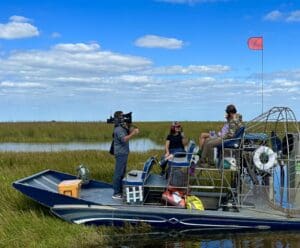
Airboats are more than just a fun way to see alligators and wide‑open marsh; they are a tool that helped people reach and understand the Everglades long before roads and boardwalks existed. For River of Grass Adventures, airboats are the primary way to safely guide guests into the real “River of Grass” while honoring its wildlife and vegetation.
A Brief History of Airboats in the Glades
The first airboat prototypes appeared in the early 1900s, when aviation pioneers experimented with flat-bottomed hulls pushed by aircraft-style propellers and engines instead of underwater motors. Florida registered one of the earliest airboats around 1920, but the designs really took off in the Everglades in the 1940s, when locals and Gladesmen began building their own backyard boats specifically to cross shallow, grassy wetlands that traditional boats could not handle.
Over time, airboats evolved from homemade “fan boats” into specialized vessels, being used for everything from hunting and fishing to law enforcement, search and rescue, and eco‑tourism. Today, they are a defining part of Everglades culture and one of the few ways to reach vast interior marshes that remain otherwise inaccessible.
How Airboats Move Without Churning the Water
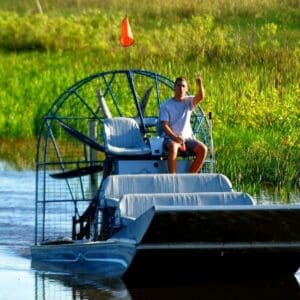
An airboat is a flat‑bottomed vessel powered by a large aircraft-style propeller mounted above the waterline. Instead of using an underwater propulsion system, the engine drives the fan, which pushes air backward and the boat forward; steering comes from rudders that sit in that airflow, not in the water.
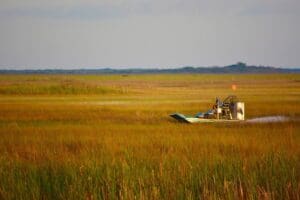
Because there are no moving mechanical parts below the surface, airboats can skim over shallow water, vegetation, and even exposed mud without tearing up plants or churning sediment like traditional propeller boats often do. This design is exactly why they became the main mode of navigation across the Everglades’ “River of Grass,” where water is shallow, vegetation is dense, and submerged motors would quickly bog down or damage habitats.
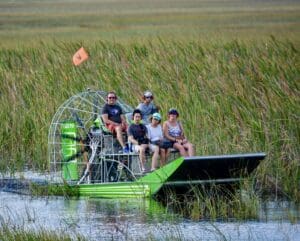
Why Airboats Are Often the Least Invasive Motorized Option
In shallow marshes, traditional boats rely on submerged propellers that stir up sediment, cut aquatic plants, and can injure fish, reptiles, or other aquatic life near the surface. Airboats, by contrast, glide on a flat hull and use air thrust; when operated responsibly, they avoid direct contact with underwater vegetation and wildlife, making them one of the least invasive motorized ways to move through these habitats.
This is why airboats are widely used by natives, Gladesmen, conservationists, scientists, and land managers: they provide essential access for research, invasive species control, rescue operations, and water management work without the constant underwater disturbance caused by in-water propeller-driven boats. Healthy ecosystems in the Everglades depend on active stewardship— not abandonment in the name of “leaving no trace.” You cannot protect what you do not truly know, and you cannot truly know a landscape like the Everglades without responsibly exploring and studying it. Thanks to the Airboat, this is all possible.
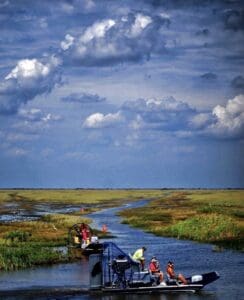
River of Grass Boats vs. Big Park Concession Airboats
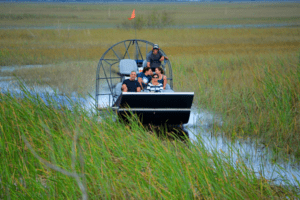
Not all airboats are created equal. River of Grass Adventures operates what many locals call “grass boats”: shallow-hulled vessels with a maximum capacity of 8 passengers, built to stay small, maneuverable, and low‑impact in the marsh. These boats are closer to traditional Gladesmen-style airboats than the very large park concession airboats that can reach 30–35 feet in length and carry around 30 passengers. Smaller boats like those at River of Grass Adventures are purpose‑built for intimate, immersive, low‑impact exploration: fewer guests, lighter hulls, and routes chosen with Everglades flora and fauna in mind.

Stewardship Through Responsible Exploration
When operated responsibly, airboats become a bridge between people and the protected landscapes they might never otherwise see or learn about. For River of Grass Adventures, every airboat tour is both an adventure and an opportunity: to teach guests how the Everglades works, why restoration matters, and how everyday choices affect water, wildlife, and future generations.
By choosing a small airboat experience, visitors aren’t just gliding across the River of Grass; they are supporting a form of access that balances adventure, education, and conservation. That balance is the heart of vital conservation and sustainable eco‑tourism in the Florida Everglades.