
The Everglades River of Grass forever changed how we see Florida’s wild heart, thanks to Marjory Stoneman Douglas’s groundbreaking 1947 book that reframed the Everglades from a worthless mucky swamp to a dynamic, flowing river of life.
“There are no other Everglades in the world. They are, they have always been, one of the unique regions of the earth, remote, never wholly known. Nothing anywhere else is like them; their vast glittering openness, wider than the enormous visible round of the horizon, the racing free saltness and sweetness of their massive winds, under the dazzling blue heights of space. They are unique also in the simplicity, the diversity, the related harmony of the forms of life they enclose. The miracle of the light pours over the green and brown expanse of saw grass and of water, shining and slow-moving below, the grass and water that is the meaning and the central fact of the Everglades of Florida. It is a river of grass.”
– Marjory Stoneman Douglas, The Everglades: River of Grass, 1947
Early Florida and the Swamp Myth
Long ago in Florida history, the Everglades felt like a wild mystery. Spanish explorer Ponce de León skirted it’s edges, while 19th century settlers and developers dismissed it as a buggy, flooded wasteland, ripe for draining.
By the early 1900s, man made canals and levee systems—pushed by Florida’s 19th governor, Napoleon Bonaparte Broward—had slashed its natural watershed, threatening ecosystems that sustained native tribes and teeming wildlife for millennia. Broward campaigned in 1904 on a bold promise to “drain that abominable pestilence-ridden swamp,” viewing the Everglades as reclaimable land for agriculture and development
Douglas was born in 1890 in Minneapolis, Minnesota. She moved to Miami in 1915 to work at the Miami Herald, where her father was an editor. As a journalist and editor herself, she reported on local south Florida issues and began to appreciate the Everglades’ subtle beauty amid its challenging landscape.This sparked her lifelong passion for conserving Florida’s unique wilderness.
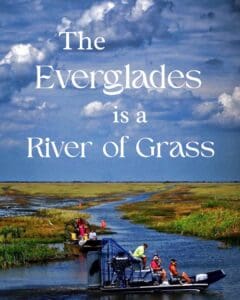
Revolutionizing the Everglades River of Grass
Published amid post-war development booms, Everglades: The River of Grass was no boring textbook. Douglas wove science, Native lore, and her beautiful writing style into a narrative revealing the Everglades River of Grass as a 100-mile-wide slow moving river which extended from Lake Okeechobee to the Florida Bay—a living artery, not a swamp. She coined the iconic phrase “River of Grass,” capturing sawgrass prairies pulsing with alligators, birds, aquatic life, and Everglades flora in rhythmic floods.
This shift shattered stereotypes. Before Douglas, politicians eyed the Everglades for farms and cities; after, it sparked an outcry against draining that had already destroyed half of the Everglades wetlands. Her book, blending Florida history with urgent ecology, sold modestly at first but ignited conservation, paving the way for Everglades National Park in 1947.
Legacy in Everglades River of Grass Restoration
Douglas lived to 108, crusading into the 1990s against Big Sugar and urban sprawl. Her influential writings inspired generations to protect Florida’s wild heart.
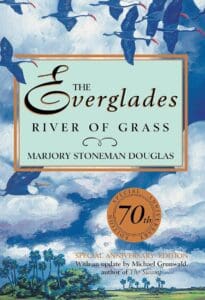
The Everglades is a test. If we pass it, we may get to keep the planet. – Marjory Stoneman Douglas
For Everglades ecotour operators like those at River of Grass Adventures, her influence runs deep—guiding tours that show visitors the real living river she championed. Grab Everglades: The River of Grass on Amazon to grasp why this cornerstone of Florida history endures still to this day.